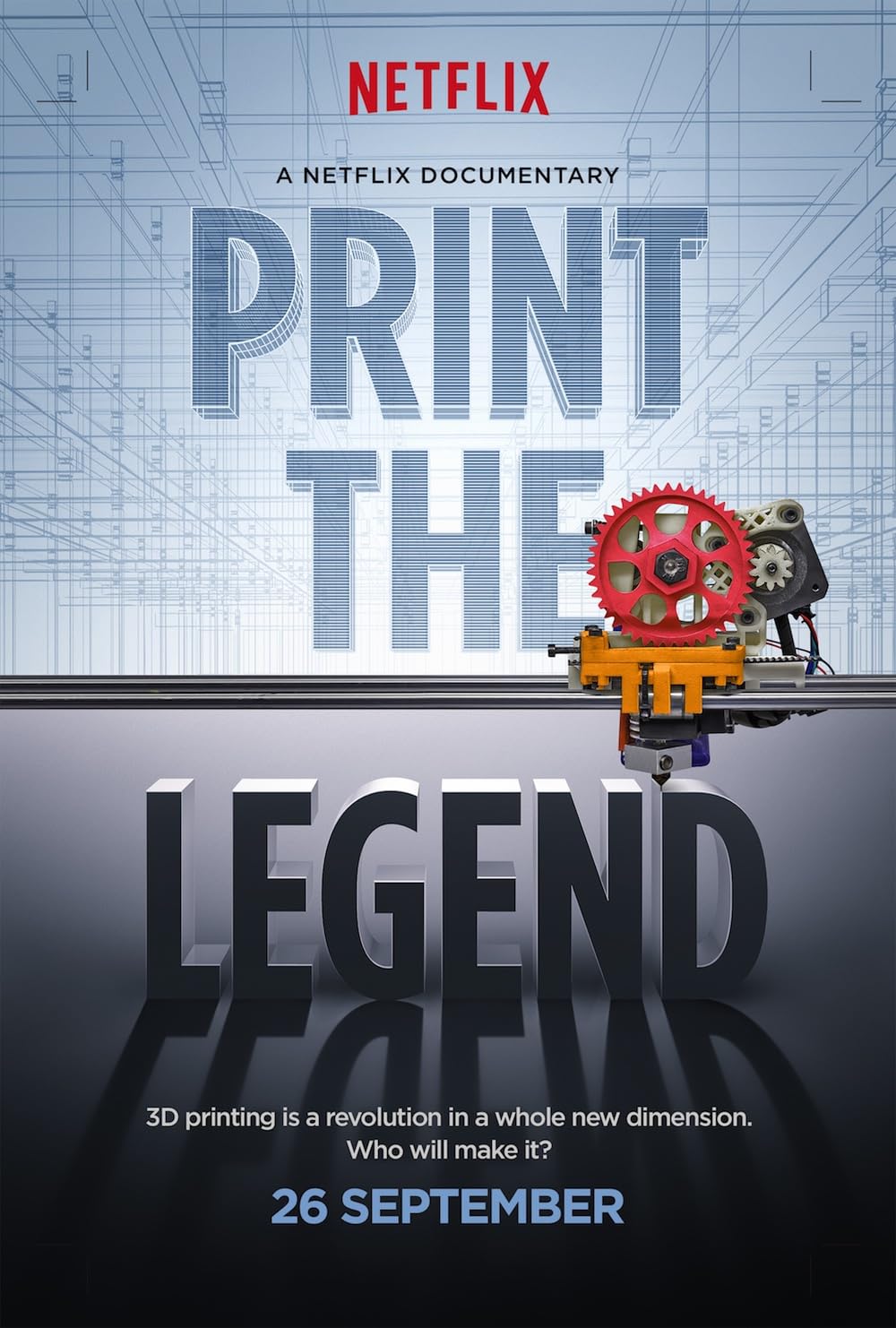

Print the Legend (2014) follows the early years of the 3D printing industry, at the moment when the technology was suddenly announced everywhere as the next industrial revolution. The documentary mainly looks at companies like MakerBot, Formlabs, and 3D Systems - startups and established players trying to build a completely new market.
What starts as an idealistic story about makers and open source, gradually turns into a battle for patents, investments, and scale.
What is Print the Legend about?
At the beginning of the documentary, you see how enthusiastic the community around 3D printing is. Engineers, hobbyists, and startups believe that soon everyone will be able to print their own products: from parts to consumer products.
But as soon as the technology becomes commercially interesting, the dynamics change. Open-source projects clash with commercial interests, investors step in, and companies must decide whether to remain community-driven or go fully commercial.
Technology and the reality of growth
An important theme in Print the Legend is the difference between technological promise and practical execution. Many companies present 3D printing as a revolution, but in practice, scalability proves challenging: machines are expensive, materials are limited, and applications are less universal than initially thought.
The documentary shows how startups deal with that tension between ambition and reality.
Innovation under pressure from investors
Once venture capital comes in, the dynamics within companies also change. Product development must be faster, competitors become more aggressive, and the pressure to gain market share increases.
The film shows how technical choices are sometimes influenced by investors and market expectations — a recognizable dynamic for many technology companies.
From experiment to commerce
Print the Legend shows how a technology evolves from experimental project to commercial industry. It not only showcases the technical innovation but also the business and strategic choices that determine which companies ultimately survive.
For professionals working with hardware, startups, or new technologies, it is an interesting case about hype, competition, and the reality of building a new market.